
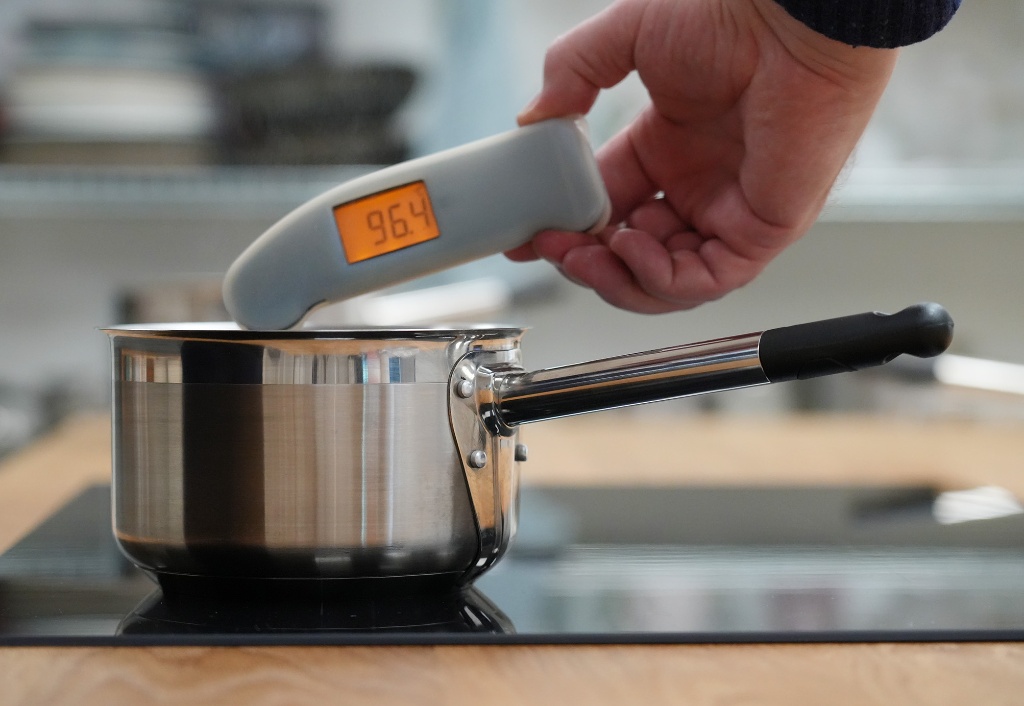
Temperature Control on Cooktops – How It Works
On most cooktops, you control how much energy is supplied, but not the temperature of the pot or pan. Therefore, traditional cooking requires experience, attention, and continuous adjustment of the heat.
Here we review the difference between manual and automatic temperature control as well as the most common types of temperature sensors.
Manual Temperature Control Without a Thermometer
Manual temperature control of pots and pans has not changed, in principle, since using open fire for cooking. You moved your pot closer to or further away from a fire.
Although automatic temperature control has long been a given with radiators, washing machines, irons, and ovens, it has only started to change in recent years when it comes to cooking on a cooktop.

On a classic stove, you also don't have temperature control. You control how much heat is supplied to the cookware. The heat then accumulates in the cookware, and the temperature rises more and more.
If you don't add food or water, the temperature will rise until it becomes so high that the cookware melts.
When you turn the heat up and down in empty cookware, it rises slower or faster. It does not go down. The temperature can practically only go up.

When you then add food or water to your cookware, the temperature drops, and more heat needs to be supplied by turning up the heat.
So it's a dance between how much the heat causes the temperature to rise and how much the food causes it to fall. It takes a long time to become good at it, and you need to keep an eye on the food all the time to prevent it from burning or boiling over.
Temperature Control with a Thermometer
Solid plates, glass-ceramic, spiral broilers, and gas are not precise and/or fast enough for temperature control. The heat transfer to the cookware is too inefficient, so it takes too long from when you turn the heat up or down until it affects the cookware. Therefore, the temperature will fluctuate up and down.
Induction cooktops with different types of temperature control have finally started to appear in recent years. They are quite good at controlling the heat quickly and precisely several times per second via a built-in computer.
The biggest problem with temperature control, however, is measuring the temperature in the cookware. Here, it makes a huge difference which type of sensor you use to measure the temperature with and where it is placed.
So let's look at the options available right now.
External Sensor
These are sensors that can be attached outside the cookware, which then measure how hot it is where the sensor is located.

The advantages of this method are that it is cheap and can be used on all cookware. It works well for deep frying and for poaching and boiling. Or for slow simmering dishes.
The disadvantages are that the liquid must reach up to where the thermometer is located for it to work. So you need to make large quantities as it is positioned a bit away from the bottom.
You cannot use it for frying, sautéing, or other things where you mainly use the bottom.
If you are frying something, you want to know what the temperature is at the bottom of your pan. When you want to create a perfectly seared crust, it doesn't help if the sensor is on the side.
The same applies if you want to make real sauces like hollandaise and béarnaise, vanilla cream, or temper chocolate. It is super important that the bottom does not get too hot, so everything separates.
The bottom heats up much faster than the contents of the pot. So if you set the heat to “9” or "P", the bottom can become hundreds of degrees and burn. Before the sensor on the side can detect that the contents have reached a high temperature.
Worse still, if you evaporate so much of the liquid that the surface drops below the thermometer, the thermometer suddenly shows that it is “room temperature”. The stove then turns up the heat, and it starts to boil over.
There can also be fire hazards if the liquid has boiled away and only oil or fat remains in the cookware under the sensor.
The thermometer that sits outside is also not as precise, so it is not suitable for sous vide, for example.
Probe Sensor
A probe sensor is very similar to the external sensor in advantages and disadvantages. But because it is submerged in liquid in the cookware, it is much more precise and can be used for sous vide. Depending on whether the cooktop can be set with 1-degree accuracy. It is also great for deep frying.
But again, it requires that it is submerged in liquid, so it does not work for frying and sautéing.

Sensor in the Stove
Instead of using a loose sensor, it can be built into the stove to measure the temperature at the bottom of the cookware. Either with a probe that touches the cookware or infrared sensors that measure the temperature up through the cooktop. Some also use a thermometer located under the cooktop's glass plate.
Stove sensors have the advantage that you can use almost any cookware that can be used for induction. For example, special cookware like an aebleskiver pan and pancake pan can still be used.
The disadvantages are that it is not super precise, and it is very expensive to build cooktops where holes need to be cut in the glass plate to make room for sensors. So the finished cooktop will often end up being extremely expensive. Such cooktops also typically have only one zone with a sensor out of the 4-6 zones on the cooktop.
Mechanical Sensor in the Stove
The mechanical sensor is typically spring-loaded and presses against the cookware. It is relatively precise compared to other external sensors. Often +-10 degrees in practice.

It is a requirement that the sensor is completely clean and dry. So if something boils over on the cooktop, or there is grease or salt under the cookware, the precision becomes much less. You may end up having to clean the recess with a cotton swab or something else.
It works fine for frying, but not for more delicate things like sous vide, chocolate tempering, and real sauces. And since there is not much difference between a gentle simmer and a rolling boil, boiling is also not easy to control with that accuracy.
Infrared Sensor in the Stove
The infrared sensor looks up through the stove through a clear “window”. Where it then uses infrared technology to measure the temperature at the bottom of the cookware.

The good thing about it is that the sensor window can just be wiped off along with the rest of the stove. So cleaning is not difficult. And again, you can use all induction cookware.
The downside is that infrared technology does not directly measure the temperature of your cookware but the radiant heat. There is a big difference in radiant heat depending on the material and color of the cookware.
Black cast iron will show a completely different temperature than stainless steel. There can be up to 50°C difference in what an infrared sensor measures.
Something as simple as whether you place the cookware so the temperature is measured on a logo on the bottom, or the stainless steel right next to it, makes a big difference.
Therefore, it only works for frying, and only with coarse divisions like “low”, “medium”, and “high” heat. However, it is still a good help for that purpose.
Temperature Sensor Under the Glass Plate
Especially with cheap cooktops, you can find a solution where there is simply a thermometer under the stove's glass plate. They measure the temperature under the glass plate and not in the cookware.

So first the cookware is heated, and then the glass plate is heated by the cookware, and then the sensor can measure the temperature of the glass plate.
There can easily be a 70°C - 80°C difference. Or more. It can pretty much only be used to help prevent your deep fryer from catching fire. But it works on all cookware, and it is cheap to make.
Temperature Sensor Built into the Bottom of the Cookware
Finally, there is the solution where a sensor is inserted into the bottom of the cookware. So it measures what temperature the bottom of the cookware has.

It has the advantages that you can control very temperature-sensitive processes with 1°C accuracy.
You can, for example, temper chocolate, make sous vide, real sauces, vanilla cream, poach at low temperature, make cheese and yogurt, control boiling and frying precisely, etc. It is also suitable for deep frying.
The downside is that it requires special cookware that matches the cooktop for it to work. So the price of the cookware can be higher. On the other hand, the stove is not significantly more expensive, as holes and sensors do not need to be installed in the glass plate.
How Does Ztove Work?
Ztove has the type of sensor that is built into the bottom of the cookware because it is the most uncompromising solution. And we love the extra possibilities that precision provides. For example, we can create “virtual kitchen machines” like rice cookers, potato cookers, pasta cookers, popcorn machines, etc., by controlling the temperature over time with automated recipes.
Get Ztove in Your Kitchen
Do you want to cook with temperature instead of steps 1-9? Then Ztove should be your next cooktop.