
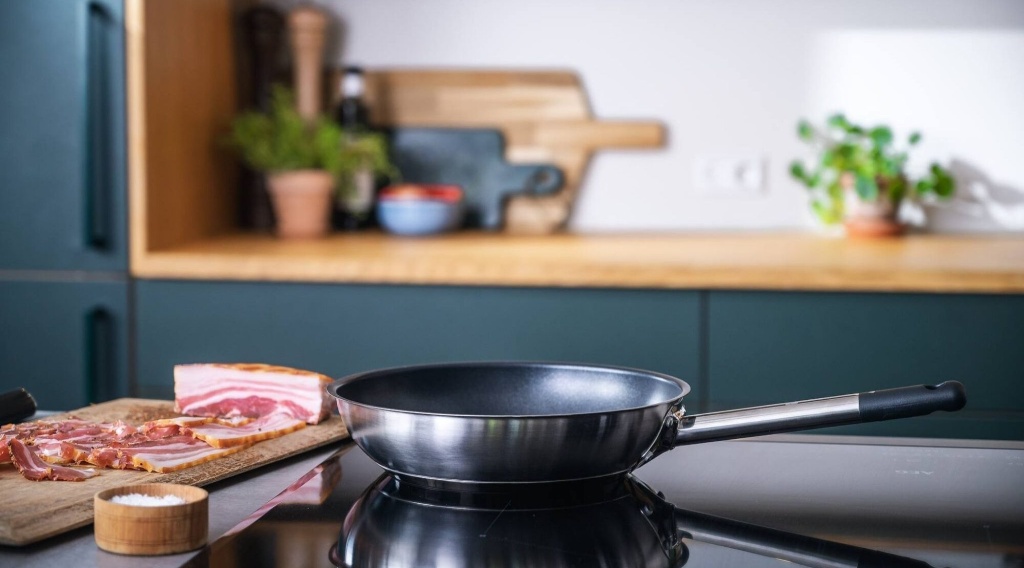
Non-stick is fantastic
Nothing sticks to your pan, and it's easy to clean. However, many find that they break after just a few years. This is almost always because they get too hot.
For all non-stick coatings, they become softer the hotter they get. At low to medium temperatures, it's actually quite difficult to damage the coating.
We have tested many types of non-stick coatings, and the Ztove pans are coated with the best we could find.
How hot your non-stick pans can get
We conducted a test where we used a metal spatula and pressed it down on a pan. A robotic arm moved the spatula back and forth 1,600 times with 1,350 g's force. We repeated this on non-stick pans at 10 °C intervals.
We then analyzed the durability by assessing how much damage the pan had taken.
The result:
Between 0-200 °C, it takes quite a bit to damage your pans. We typically recommend frying chicken breast at 170 °C and fish at around 190 °C.
From 200-220 °C, you need to be more careful. Here, if you scrape hard, you can remove some of the coating. Be careful with your kitchen utensils, and it should be fine.
Above 220 °C, all types of non-stick coatings become exponentially more fragile. At more than 260 °C – which corresponds to the smoke point of many cooking oils – the coating can come off by itself.
If you've ever had a non-stick pan that broke even though you felt you were careful with metal utensils and the like, it may very well be because it got hotter than 260 °C.
Our recommendation is to keep the temperature below 220 °C.
Additional advice
Avoid using metal utensils on Ztove non-stick pans, as they can scratch the non-stick coating. Coarse salt is also very abrasive and can damage the coating if rubbed against it.
Cooking with fats or oil at higher temperatures can lead to the fat forming a layer on top of the coating. Over time, this can damage the non-stick coating. Therefore, it is always recommended to clean with the soft side of a sponge or a soft brush and use a little dish soap over two rounds.
Make sure to place the pan correctly and centrally on the cooking zone, as incorrect placement can damage the coating along the edges due to uneven heating.