
How to Install a Cooktop with a Hood
Learn about the difference between recirculation and extraction, and get insights on how your Ztove Downdraft should fit in your kitchen.
Recirculation or Extraction?
Ztove's induction cooktop with integrated hood can be installed with both recirculation and extraction.
When the hood is on, air, steam, and cooking odors are drawn down through the cooktop. The air must then either be vented out of the house or filtered and sent back into the kitchen.
- With extraction, the air is channeled through ducts and out through an exterior wall.
- With recirculation, the air is filtered and sent back into the room.
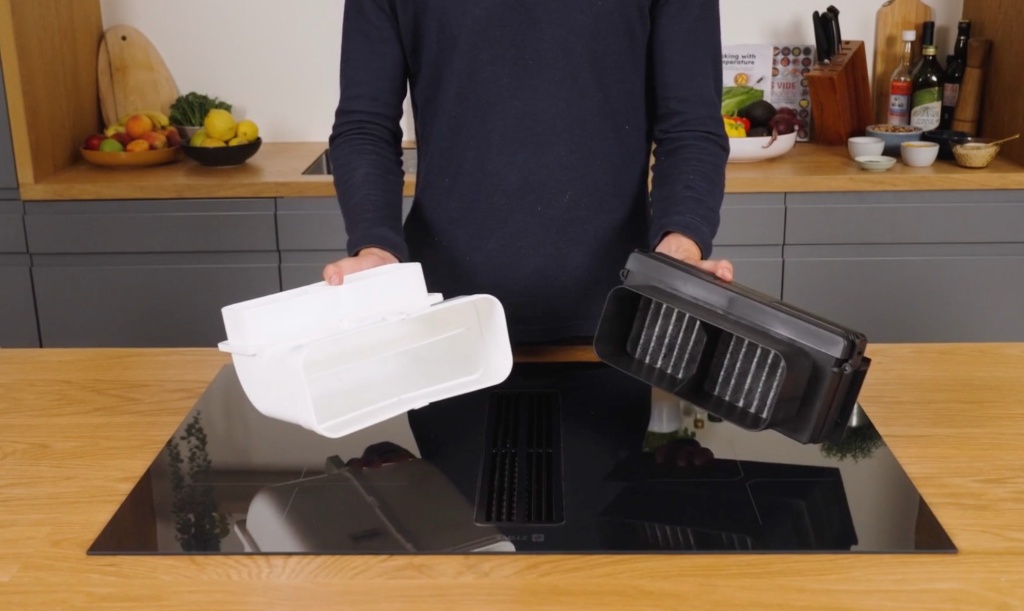
Ztove uses standard dimensions for the duct system. You can therefore use Ztove's own ducts or compatible parts from a kitchen supplier.
Installation with Extraction
For installation with extraction, the cooktop is connected to a duct system that leads air, odor, and water vapor completely out of the house.
The ducts end at a vent in the outer wall. The vent ensures that the air can escape while limiting outside air from entering the kitchen.
Advantages of Extraction
- Cooking odors, smells, and water vapor are completely removed from the kitchen.
- You do not need an active carbon filter to clean the air.
- No moist air is sent back into the cabinet or at the kitchen's baseboard.
Disadvantages of Extraction
- The installation requires access to an exterior wall or an existing extraction duct.
- More ducts and larger interventions in the kitchen may be needed.
- For a kitchen island, the ducts may need to be routed under the floor.
If you are building new or renovating, the extraction should be planned early so that the ducts can be integrated into the floor, cabinets, or walls.
Recirculation with Ducts
With recirculation using ducts, the air from the cooktop is channeled down through the cabinet and out through the kitchen's baseboard. Before the air is sent back into the room, it passes through an active carbon filter that reduces cooking odors and smells.
Advantages of Recirculation with Ducts
- The solution does not require access to an exterior wall.
- Fewer ducts are usually needed than with extraction.
- It is a suitable solution for kitchen islands and kitchens far from an exterior wall.
- The air and steam are directed away from the cabinet itself and out through the baseboard.
Disadvantages of Recirculation with Ducts
- The active carbon filter must be maintained and replaced as needed.
- Water vapor is not removed from the kitchen in the same way as with extraction.
- Ducts and filter require space in or behind the kitchen cabinets.
Recirculation without Ducts
Ztove 80 cm with integrated hood comes with a carbon filter that can be mounted directly on the cooktop's exhaust. This makes it possible to install the cooktop without a complete duct system.
The carbon filter reduces cooking odors and smells but does not remove water vapor. If the moist air is not directed away from the cabinet, condensation may occur.
If the kitchen's layout allows, the solution can later be expanded with ducts that lead the air down into the baseboard or out through the back of the cabinet.
Maintenance of the Carbon Filter
The included carbon filter can be washed and regenerated several times before it needs to be replaced. We recommend regenerating the filter approximately every two months by first cleaning it by hand or in the dishwasher and then drying it in the oven.
The filter should generally be replaced after about two years. The need may vary depending on how often you cook and how intensively the hood is used.
Always follow the current instructions for the filter when cleaning, drying, or replacing it.
Which Solution Does Ztove Recommend?
Extraction is the best solution when the kitchen allows for it. Here, cooking odors, smells, and water vapor are vented completely out of the house, and you avoid maintaining and replacing carbon filters.
The next best choice is recirculation with ducts and exhaust through the baseboard. It is a flexible solution that directs the filtered air away from the cabinet.
If none of these solutions are possible, you can use the included carbon filter directly on the cooktop. Just be aware of ventilation and the risk of condensation in the cabinet.
Plan the Installation Before the Kitchen is Assembled
Investigate in advance where ducts, filter, and any exhaust should be placed. Also, check that there is sufficient space in the cabinet under the cooktop.
In new construction or kitchen renovation, the solution should be agreed upon with the kitchen supplier before cabinets, countertops, and floors are installed. The cooktop itself must be connected by an authorized electrician.
Read more about Ztove 80 cm induction cooktop with integrated hood